After entering your height and weight into a myagebmi.com calculator and receiving a number, the next step may not be immediately clear. How reliable is this site? Is your BMI result right for your age? What exactly is a “normal” reading concerning your health? (10 words)
This guide has all those answers. We took an in-depth look at myagebmi.com what it offers, how it uses your data, what the science has to say about BMI accuracy and when you should see a doctor rather than rely on a free online tool.
Medical disclaimer
This article shouldn’t be considered as medical advice which contains any diagnosis or treatment only for general information. One must converse with a licensed healthcare professional about their weight, BMI, and health decisions. Never use an online calculator or article to start taking or stopping medication or diet, or changing surgery.
Quick Answers
- What is myagebmi.com?–> A free health calculator site with a BMI calculator, an age calculator, a water calculator and over 30 health calculating tools.
- [Is it safe to use?] yes the site says “your health data is NOT stored anywhere. It is input into your browser directly (where it stays because it is not sent anywhere)”.
- Is the BMI formula correct?-> The calculation is correctly the standard WHO / CDC formula, however BMI is generally flawed for athletes, elderly people and some ethnic groups.
- Is it supposed to be medical advice?->No – it is just a screening tool, a single value can‘t diagnose a condition
- Most appropriate for: adults who want a rapid, free estimate of their weight category (not for clinical diagnosis)
What Is myagebmi.com?
Myagebmi.com is a free, on-line health calculator website which you may use to assist you in calculating your Body Mass Index (BMI), accurately determine your age, keep record of your daily water consumption, and make use of a large library of health and fitness tools.
This website was built by Nitin Nikode, a blogger and content creator based out of Maharashtra, India who designed the site as a helpful resource for those seeking to track basic health statistics without having to go to a hospital.
Who Created It — and Does That Matter for Accuracy?
Nitin Nikode is a solo developer and health content creator, not a physician or Registered Dietitian. This is relevant background: the BMI formula is a static math calculation developed by the WHO and CDC any properly constructed calculator will give the same result, no matter who developed it.
Where creator credentialsdomatter is located in the interpretation guidance and health advice around the number. myagebmi.com provides standard category descriptions and reasonable disclaimers but no clinical interpretation. Think of it as a quality calculator app — accurate at the math, but appropriately limited in what it can tell you about your individual health.
Is myagebmi.com Legitimate?
Yes. An active, ad-supported health application without any apparent indication of malware, phishing, or false health claims. Clearly states it is a medical disclaimer that ‘our tools are for information only and are not intended to be a substitute for professional health advice’. No major red flags on domain name.
That said, it has no medical editorial board, no registered healthcare professionals listed, and no formal peer review process — details worth noting for a YMYL (health-related) category site.
What Tools Does myagebmi.com Offer?
The site has grown well beyond a simple BMI calculator. As of 2025, it offers more than 30 tools across four areas:
Core Health Calculators
- BMI Calculator — standard adult formula; provides category and health tips
- Age Calculator — calculates your exact age in years, months, and days
- Water Intake Calculator — estimates daily hydration needs based on weight and activity
- Blood Pressure Level Checker
- Ideal Weight Calculator
- Body Fat Percentage Calculator (uses US Navy method)
- BMR Calculator (Basal Metabolic Rate)
- Sugar and Salt Intake Calculators
- Pregnancy Due Date Calculator
- Waist-to-Hip Ratio Calculator
Fitness and Nutrition Tools
- Calorie Calculator and Calorie Burn Estimator
- Protein Intake Calculator
- Macro vs Micro Nutrient Analyzer
- Meal Plan Generator (including an Indian Diet Chart)
- Keto Diet Calculator
- Intermittent Fasting Timer
- VO2 Max Estimate Tool
- Heart Rate Zone Calculator
- Running and Walking Pace Calculators
- Sleep Cycle Calculator
- Fitness Goal Planner
- Daily Activity Level Analyzer
This range is notable for a free site. Most comparable tools offer 3–5 calculators; myagebmi.com has positioned itself as a wellness dashboard.
How to Use the BMI Calculator on myagebmi.com
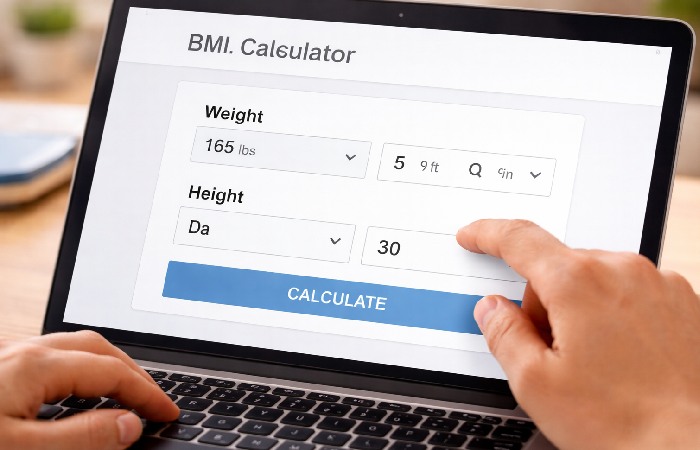
Entering height and weight to calculate BMI accurately
The BMI calculator is the site’s main feature. Here’s how to use it accurately:
- Go to myagebmi.com and the BMI Calculator appears on the homepage.
- Choose your unit system — metric (kg/cm) or imperial (lbs/inches).
- Enter your weight as accurately as possible (use a reliable scale; do not estimate).
- Enter your height — if using feet and inches, enter both fields carefully.
- Enter your age — the tool uses this to provide contextual tips, though the adult BMI formula itself does not change by age (see the section below on age and BMI).
- Select your sex if prompted (some calculators adjust interpretive tips by sex).
- Click Calculate — your BMI number, category, and health guidance appear instantly.
- Read the result in category context, not as a diagnosis. Note which of the four standard categories your result falls into.
Important: The tool processes your inputs in your browser only. No data is sent to or stored on the site’s servers unless you use a “save results” feature, which only stores data in your device’s local browser storage.
Understanding Your BMI Result
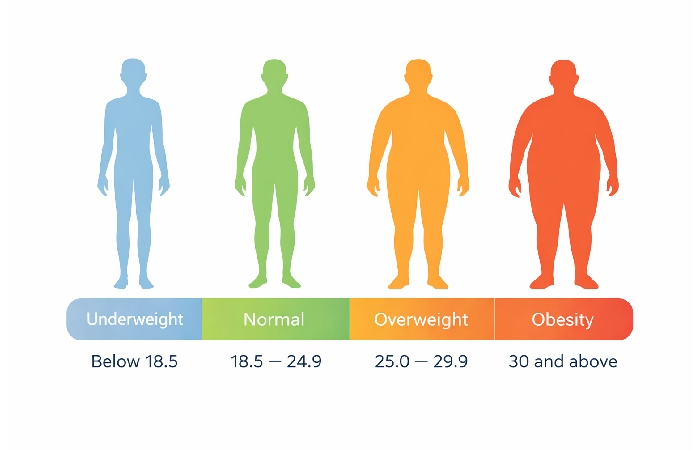
Standard BMI ranges and their health classifications
Standard Adult BMI Categories (WHO / CDC)
| BMI Range (kg/m²) |
Category |
General Health Signal |
| Below 18.5 |
Underweight |
May signal nutritional deficiency or other conditions |
| 18.5 – 24.9 |
Healthy (Normal) Weight |
Associated with lower chronic disease risk |
| 25.0 – 29.9 |
Overweight |
Elevated risk for some conditions |
| 30.0 – 34.9 |
Obesity (Class I) |
May be associated with higher risk; lifestyle changes and a clinical review are often advised. |
| 35.0 – 39.9 |
Obesity (Class II) |
Significantly elevated risk |
| 40.0 and above |
Obesity (Class III) |
Highest risk; clinical assessment strongly recommended |
Source: CDC Adult BMI Categories
These ranges apply identically to all adults aged 20 and over, regardless of sex. (Children and teenagers use a different system — see below.)
Does Your BMI Differ by Age?
For adults (20+), the standard BMI formula and categories do not change based on age. A BMI of 22 means the same category for a 30-year-old and a 65-year-old — but it does not necessarily represent the same health risk. This is one of BMI’s most important limitations, discussed in the next section.
For children and teenagers (2–19), BMI is interpreted completely differently. Rather than fixed categories, BMI is plotted on age- and sex-specific percentile growth charts developed by the CDC. A BMI-for-age at or above the 95th percentile indicates obesity; below the 5th percentile signals underweight. myagebmi.com’s standard adult calculator is not appropriate for children — a point the site itself acknowledges in its disclaimer. The CDC offers a separate, dedicated child/teen BMI tool.
Limitations of the BMI Calculator — Read Before Acting on Your Result
BMI is a useful screening tool, but calling it a measure of health is an overstatement. According to the CDC, BMI measures weight relative to height — not body composition. That distinction matters more than most people realize.
Athletes and High Muscle Mass
And we‘d like to remind you that muscle weighs more than fat. It is very common for a body builder or someone training for strength to have a BMI greater than 25 “overweight” in BMI terms when actually they are carrying very little body fat. Your BMI result is “correct” but is very missleading. If you are active and have a fair amount of muscle mass you should read your BMI result as a guide, not a verdict.
Older Adults and Muscle Loss
Here’s where BMI becomes genuinely unreliable for a large group: older adults. As people age, muscle mass naturally declines — a process called sarcopenia. Body fat often increases in its place, particularly around the abdomen, even as total body weight stays similar.
The result: an older adult with a “healthy” BMI of 23 may actually have significant excess body fat and low muscle mass — a combination linked to increased frailty and metabolic risk. This is sometimes called sarcopenic obesity, and a calculator cannot detect it.
For some adults over 60, waist circumference and body fat percentage can provide more useful health signals than BMI alone.
If you are over 60, a “healthy” BMI can mask low muscle and higher body fat levels. This is where your doctor might use other measurements such as waist circumference or bodycomposition tests rather than just the number.
Ethnic-Specific Thresholds
Standard BMI categories were developed largely using data from white European populations. Research has since shown that people of Asian descent, for example, face elevated risks for type 2 diabetes and cardiovascular disease at lower BMI values — often beginning around 23 kg/m², rather than the standard 25 threshold. Some health organizations now recommend adjusted cut-offs for Asian populations, though myagebmi.com uses the universal WHO categories.
If you are of South Asian, East Asian, or Southeast Asian heritage, a BMI in the “healthy” range under standard categories may still warrant a conversation with your doctor.
Is myagebmi.com Safe? What Happens to Your Data?
This is the most common concern about free health calculator sites — and a fair one.
Published disclaimer for myagebmi. Com states: When you enter your data (age, weight, height, dob) it is calculated completely within the application running in your web browser in JavaScript and is not sent to, or saved on, myagebmi.com‘s servers, nor is any data of yours saved on a myagebmi. Com database. Any saved results are saved in your own browser local storage.
That‘s a reasonable protection of privacy for a free tool. It simply ensures that when you use the BMI calculator, your health information isn‘t stored on other people‘s servers.
A few reasonable precautions still apply:
- Use HTTPS– Verify the padlock symbol exists in the address bar of your browser before inputting any personal information.
- Be wary of cookies This website uses basic analytics cookies, which you can modify in your web browser.
- Stay away from revealing medical data by confirming that there aren‘t the initials of a health measurement or mass alongside them. Never put your entire name with serious health measurements on any free sites.
- Review the site‘s ads. Ad-supported sites will display third-party content, so exercise your judgment when clicking on third-party links.
Overall, for a tool of its type, myagebmi.com follows reasonable data handling practices.
myagebmi.com vs. Other Free BMI Tools
| Feature |
myagebmi.com |
CDC BMI Calculator |
NIH NHLBI Calculator |
MedicineNet |
| Free to use |
✅ |
✅ |
✅ |
✅ |
| Adult BMI calculator |
✅ |
✅ |
✅ |
✅ |
| Child/teen BMI (percentile) |
❌ |
✅ |
❌ |
❌ |
| Additional health tools (30+) |
✅ |
❌ |
❌ |
Limited |
| Medical editorial oversight |
❌ |
✅ (federal agency) |
✅ (federal agency) |
✅ (physician-reviewed) |
| Data stored on servers |
❌ |
❌ |
❌ |
Varies |
| Ads/monetized |
✅ |
❌ |
❌ |
✅ |
| Ethnic-adjusted thresholds |
❌ |
Not in calculator |
Not in calculator |
Limited |
Bottom line: The calculator numbers match across all 4 tools because they use the same formula. Myagebmi.com wins on cross-tool variety; the CDC and NIH wins on institutionality and child/teen-specific tools.
When it comes to kids and teens, the CDC and NIH methods are best because they use age- and sex-specific BMI percentiles. For adults, myagebmi.com is best, since it is a one-stop-shop for quick check-ups plus greater number of calculators for overall wellness.
Common Mistakes People Make When Using BMI Calculators
1. Treating the number as a medical diagnosis. A BMI of 27 is not a clinical condition — it is a risk indicator. No single metric determines your health.
2. Does not take into account muscle mass. If you regularly do weight training or compete in sport your BMI will give a false indication of your health risk. When used with a body fat estimate it will give a more accurate picture.
3. Using the adult calculator for children or teenagers. Children’s BMI must be interpreted using age and sex-specific percentile charts. The CDC’s child/teen calculator is the right tool for anyone under 20.
4. Ignoring where fat is stored. A BMI of 29 with most weight carried around the abdomen carries much higher cardiovascular risk than the same BMI with weight distributed elsewhere. Waist circumference adds important context.
5. Checking once and never again. BMI is a snapshot, not a health grade. It’s most useful as a trending metric — tracking direction of change over months, not as a one-time verdict.
Who Should Use myagebmi.com — and Who Should See a Doctor First
myagebmi.com works well for:
- Adults who want a quick, free ballpark check of their weight status
- Fitness beginners tracking basic health metrics as they build new habits
- People who recently used the CDC or NIH calculator and want additional wellness tools (BMR, calorie needs, etc.) in one place
- Anyone who needs a daily water intake or sleep cycle estimate
Use it with extra caution — and consult a doctor — if you are:
- An athlete or over-muscular individual (your BMI could be deceptively high)
- More than 60 (the value of BMI often underestimates body fat because of age related decline in muscle mass)
- South Asian, East Asian, or South East Asian (standard cut-offs may not represent your actual risk)
- Pregnant (BMI is meaningless during pregnancy)
- Being underweight or having an unexplained weight loss of… Warrants a doctor‘s visit, not an on-line calculator.
- Applying results to guide medication/diet/surgical decisions
Final Verdict
myagebmi.com is a functional, free, and reasonably responsible health calculator tool. The BMI formula is standard and correct. The site’s data privacy practices — browser-local processing, no server storage — are better than many ad-supported health sites. The tool suite is genuinely broad and useful for everyday wellness tracking.
Its limitations are not unique to this site — they are limitations of BMI as a metric. The tool cannot tell you how healthy you are. It can tell you where your weight-to-height ratio falls on a standardized scale, and that is a starting point worth knowing.
For most adults using it out of general curiosity or basic health awareness, myagebmi.com is a perfectly reasonable free tool. If your result falls outside the healthy range — or if you have underlying health conditions — do not act on that number without a conversation with a qualified healthcare provider.
A number from a calculator is context. A doctor gives you your actual picture.
Frequently Asked Questions
Q: Is myagebmi.com free to use?
A: Yes, completely. All calculators on the site — BMI, age, water intake, BMR, and all others — are free with no signup required.
Q: Does myagebmi.com store my health data?
A: From what the site says in its own disclaimer: Data you input into the calculator is processed locally by your browser; it isn‘t sent to or stored on our servers. Any saved data that you retrieve is stored locally on your own browser.
Q: Is the BMI calculator on myagebmi.com accurate?
A: The calculator uses the WHO/CDC standard adult BMI formula, and this is correct- mathematically. BMI is controversial as a true measure of health- it ignores things such as muscle/fat distribution, changes in body composition as you get older and variation in optimum health risk thresholds based on ethnicity. Treat the figure as a guide-line, not a diagnosis.
Q: Can I use myagebmi.com to check my child’s BMI?
A: The adult‘s BMI calculator (on myagebmi.com) cannot be used for children or teenagers under 20. For children and teens, the BMI values need to be referenced against the sex-specific, age-specific percentile chart. Their own CDC calculator is designed for children and teens.
Q: What is a healthy BMI for my age?
A. The classification of adults ≥20 years is not different across different ages within the adult category: < 18.5(Underweight), 18.5-24.9(Healthy Weight), 25-29.9(Overweight), 30+(Obesity). In the elderly population, healthy body weight according to BMI may coincide with excess fat of body mass because of loss of muscle tissue- calorie wastage and may therefore need the aid of other parameters as standards for healthy weight.
Q: Who made myagebmi.com?
A: Created by Nitin Nikode, a blogger and author from Maharashtra, India. He is not qualified or licensed medically, but the BMI data provided has been collated using the recognized WHO/CDC methodologies. There are adequate medical disclaimers. The site has not claimed clinical authority.
About this review
This review utilizes information accessible to the public on myagebmi.com as well as general direction about BMI from the CDC, WHO, and other health organizations. This paper has not been written or reviewed by a medical doctor and should not be seen as doctors’ advice.
About Healthbloomin
Healthbloomin.com produces useful, digestible educational text about health, technology, business/marketing, and life. They follow a primary rule of writing text based on high quality, publicly available information, only using artificial intelligence tools to assist in researching, structuring, and simplifying ideas so that the reader can concentrate on usability rather than obscure terminology or unwieldy prose.