It’s a Tuesday night, and a hospital unit manager is staring at three open shifts. The nurses scheduled to cover them called out sick. The float pool is dry. The staffing office can’t find anyone willing to pick up extra hours. Patients are coming in, and the ratios are about to slip past the point where anyone is comfortable.
This scenario plays out in hospitals every single day. What looks like a scheduling headache is actually the surface-level symptom of a structural workforce problem that has been building for years. The nursing shortage isn’t new, but it has reached a scale where traditional hiring and agency models can’t absorb the gap on their own.
Contingent nursing has emerged as one of the most practical answers to that problem – not as a temporary fix, but as a genuine workforce strategy that more hospital systems are building around.
What is Contingent Nursing Talent?
Contingent nursing refers to temporary, flexible nurses hired on a per-shift, per diem, short-term contract, or seasonal basis rather than as permanent full-time employees. The category covers several arrangements: per diem nurses who pick up individual shifts, travel nurses on multi-week contracts, local contract nurses working at a single facility for a defined period, and float pool extensions that give hospitals bench depth without carrying more full-time headcount.
The “PRN” model – meaning nurses hired as-needed – has existed for decades. What’s changed is the scale and the technology. Historically, hospitals relied on agency intermediaries to fill those gaps, which added time, cost, and limited control over who showed up. Today, platforms built around contingent nursing talent give hospitals direct access to vetted nurses without the delays and markups of traditional agency contracts.
It’s worth distinguishing between contingent staffing as a reactive placement – calling an agency when a shift opens – and contingent workforce management as a proactive strategy. The former is a short-term patch. The latter is a way of designing the workforce so that flexibility is baked in rather than bolted on after the fact.
Why Hospitals are Relying on it More Than Ever?
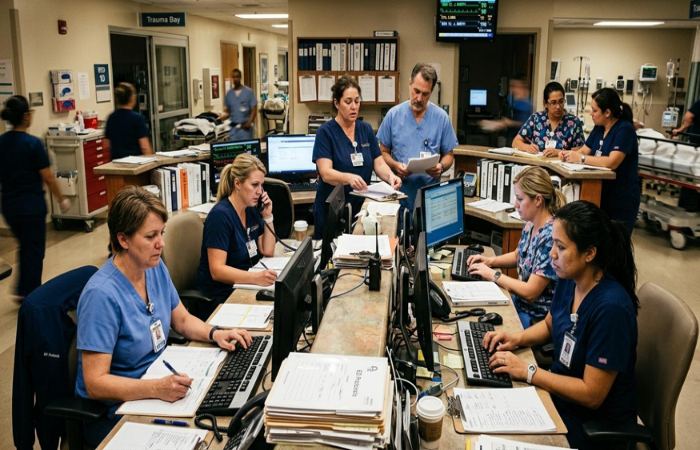
The gap between available nurses and open hospital shifts has widened every year since 2020.
The numbers here are hard to argue with. The Health Resources and Services Administration projects a shortage of about 78,610 full-time RNs by 2025, according to the HRSA Bureau of Health Workforce. Non-metro areas are facing a 14% shortfall between 2026 and 2036, which means the problem is not evenly distributed – rural and underserved facilities are taking the worst of it.
The National Council of State Boards of Nursing (NCSBN) reported in 2023 that more than 138,000 nurses left the workforce between 2020 and 2023. Nearly 40% of the nurses who remain intend to leave by 2029. That’s not attrition. That’s a wholesale exit from the profession.
Even hospitals that want to fill permanent roles often can’t, because the pipeline is broken upstream. The American Association of Colleges of Nursing (AACN) reported in 2024 that 65,766 qualified nursing school applicants were turned away in 2023, not because they weren’t good enough, but because programs didn’t have the faculty or the budget to accept them. With RN openings projected at about 189,100 per year through 2034, according to the AACN Nursing Shortage Fact Sheet, the supply side simply can’t grow fast enough to meet demand.
The NSI National Health Care Retention and RN Staffing Report 2025 found that average hospital RN turnover was 16.4% in 2024, with each nurse departure costing the facility about $56,000 in recruiting and retraining costs. A mid-sized hospital with 200 nurses and a 16% annual turnover rate is burning through more than $1.7 million a year just replacing people who left.
Understanding why so many nurses are leaving means looking at the systemic pressures pushing nurses out of permanent roles – burnout, moral injury, understaffing, and the sense that permanent employment offers fewer protections than it once did.
The Problems with the Old Approach
For most of the past two decades, hospitals addressed staffing gaps by calling a traditional staffing agency. The agency would source candidates, handle credentialing checks, and place nurses on short-term contracts. It worked, up to a point.
The fundamental problem was cost. Travel nurse rates peaked near $4,000 per week during the pandemic, according to Staffing Industry Analysts 2025. Hospitals that couldn’t staff up through permanent hiring had no choice but to pay those rates or leave beds unstaffed. Many signed long-term agency contracts to secure supply, which locked them into pricing structures that became unsustainable once the immediate crisis eased.
The other problem was control. When a hospital contracts with an agency, the agency owns the sourcing process. The facility gets presented with candidates, but doesn’t build its own network of trusted nurses it can call on repeatedly. The result is a structural dependency: the worse the shortage gets, the more leverage agencies have, and the more hospitals pay.
The NSI report also found that 25.1% of hospitals had no measurable goals to reduce RN turnover in 2024. A facility without a turnover-reduction strategy and without direct access to flexible nurses is completely exposed when demand spikes.
How Modern Contingent Staffing Models Work Differently

Modern direct-sourcing platforms let hospital administrators review nurse profiles and fill open shifts without agency intermediaries.
Technology-driven direct sourcing significantly changes the economics of contingent staffing. Rather than routing every gap through a third-party agency, hospitals can access a pool of credentialed nurses directly and fill shifts through an app-based system. Nurses choose when and where they work. The hospital gains more control over who’s on the floor, and nurses get the autonomy that many left permanent roles to find.
This model is gaining ground fast. Staffing Industry Analysts projects the per diem nursing market will grow 3% in 2026, reaching $5.3 billion, reflecting increasing hospital adoption of the local, flexible model. Vendor Management Systems (VMS) platforms – the category that includes direct-sourcing tools – are the fastest-growing vertical in healthcare staffing, with a projected compound annual growth rate of 13.7% through 2033, according to the Staffing Industry Analysts Healthcare Staffing Report.
The nurse’s perspective matters here, too. A 2024 Nursa Health Systems Survey found that 93% of health system leaders do not believe that being employed by a health system makes a nurse more valuable than working as an independent contractor. That’s not a philosophical position – it’s a practical acknowledgment that the workforce has changed. Nurses who prefer flexibility aren’t opting out of quality care. They’re choosing a work arrangement that keeps them engaged rather than burned out.
What This Means for Patient Care
Staffing conversations in healthcare are often framed as an operational or financial problem. They’re also a patient safety problem.
When a unit is short-staffed, nurse-to-patient ratios climb. More patients per nurse means longer response times, more missed assessments, and higher rates of preventable complications. The connection between nurse staffing levels and patient outcomes is well-established in the research literature.
The AMN Healthcare 2025 Survey of Registered Nurses found that 58% of nurses report feeling burned out most days. Burnout doesn’t just affect the nurses experiencing it – it affects the patients in their care. Nurses who are overstretched make more errors, take more sick days, and leave the profession sooner, which compounds the staffing problem that created the burnout in the first place.
Contingent nurses fill the gaps that would otherwise push ratios to unsafe levels. That includes predictable peaks – flu season, summer vacation coverage, post-surgical census surges – when permanent staff alone can’t cover volume. When nurses know those gaps will be covered, their own workload stays manageable. The burnout cycle slows down.
Healthcare stands out as one of the most versatile career fields in workforce design. Hospitals that combine permanent staff, float pools, and contingent workers – rather than relying entirely on one model – have more options when demand spikes unexpectedly. The versatility of healthcare credentials is part of what makes flexible staffing architectures possible in the first place.
The Outlook for Contingent Nursing in 2026 and Beyond
The immediate shortage is stark, but the longer forecast has some nuance. HRSA projects a 3% national RN shortage by 2038 – a measurable improvement from today’s 8% – but rural areas are still expected to face an 11% shortfall. The national average will improve. The distribution of that improvement will be uneven.
The BLS projects approximately 189,100 RN job openings per year through 2034. Demand stays high regardless of how the supply side responds. Hospitals that wait for the pipeline to fix itself before developing a flexible staffing strategy will spend years absorbing costs and coverage gaps that a proactive approach could have managed.
The direction of travel in healthcare workforce management is away from reactive contingent hiring – calling an agency when something breaks – and toward proactive models that blend permanent staff, float pools, and contingent workers into a unified talent architecture. Facilities that build those models now are better positioned to absorb the continued growth in demand projected through 2030 and beyond.
Flexibility Is the Strategy
The hospital manager staring at three open shifts on a Tuesday night isn’t just solving a scheduling problem. If the facility has built a proactive, flexible staffing model, those shifts get filled through a platform that already has vetted nurses in the queue. If it hasn’t, the manager is making calls at 9 pm, hoping someone picks up.
Contingent nursing talent isn’t a substitute for fixing the structural problems in the workforce. It doesn’t replace the need for better nursing school capacity, better retention programs, or better working conditions. What it does is give hospitals a functional way to keep care running while those longer-term fixes work themselves out.
The facilities treating flexibility as a strategy rather than a stopgap are the ones that won’t get caught short when the next surge hits.