If you’re searching for the best Neutrogena sunscreen, you’re already on the right track — Neutrogena is a long‑established sunscreen brand in the U.S., widely used and recommended by many dermatologists and trusted for its science‑backed, accessible formulas. But with over a dozen options in the lineup, choosing the right one comes down to your skin type, lifestyle, and specific concerns.
This guide compares the top Neutrogena sunscreens based on formula, SPF, finish, skin compatibility, and real user feedback — so you can pick the right one the first time. Whether you have oily skin, sensitive skin, or are looking for an everyday face sunscreen, we’ve got you covered.
## Quick Answers
- I have oily, acne‑prone skin – which Neutrogena sunscreen should I use?” → Clear Face SPF 55 or Ultra Sheer Dry‑Touch SPF 100 if you want a higher SPF with a matte finish.
- My skin is dry or dehydrated – which one is best?” → Hydro Boost Water Gel Lotion SPF 50, because it combines lightweight hydration with broad‑spectrum SPF.
- I have very sensitive skin or want a more reef‑friendly option.” → Sheer Zinc SPF 50 or Mineral Ultra Sheer SPF 30, both zinc‑based mineral formulas.
- I want a daily sunscreen that feels invisible under makeup.” → Invisible Daily Defense SPF 60+ for a clear, serum‑like finish that works across most skin tones.
- I need something fast for body and outdoor activities.” → Ultra Sheer Body Mist SPF 45 for quick, even coverage on arms, legs, and hard‑to‑reach spots.
## Quick Summary: Top Picks
- Best overall: Ultra Sheer Dry-Touch SPF 100 (high protection, matte).
- Best for oily/acne-prone: Clear Face SPF 55.
- Best for dry skin: Hydro Boost SPF 50.
- Best for very sensitive / reef-focused: Sheer Zinc SPF 50 or Mineral Ultra Sheer SPF 30.
- Best daily invisible finish: Invisible Daily Defense SPF 60+.
Choose based on skin type, SPF need (30 vs 50–100), mineral vs chemical preference, and whether you’ll be in strong sun or reef-protected waters.
## Neutrogena Sunscreen Comparison Table
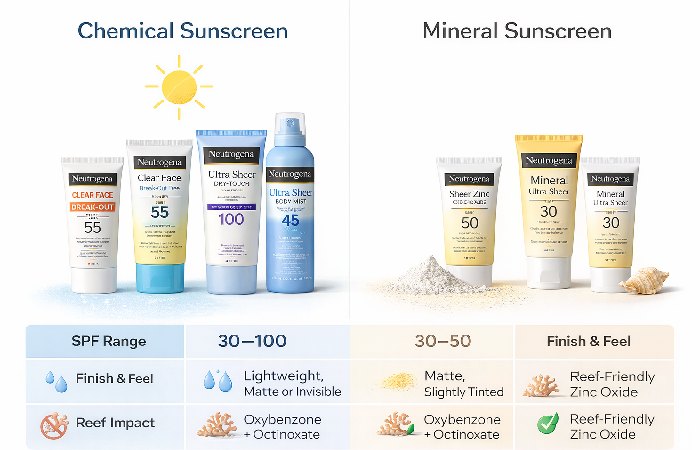
Side-by-side comparison of Neutrogena chemical and mineral sunscreens highlighting SPF range, texture, and reef considerations.
| Product |
Best For |
SPF / Type |
Key Feature |
Finish |
Price (est.) |
| Ultra Sheer Dry-Touch SPF 100 |
All-day outdoor use |
SPF 100 / Chemical |
Helioplex® technology, water-resistant 80 min |
Matte |
Typical US drugstore price range; varies by retailer and offers. |
| Clear Face Break-Out Free SPF 55 |
Oily / acne-prone skin |
SPF 55 / Chemical |
Oil-free, non-comedogenic |
Shine-free matte |
Typical US drugstore price range; varies by retailer and offers. |
| Hydro Boost Water Gel SPF 50 |
Dry / combo skin |
SPF 50 / Chemical |
Hyaluronic acid hydration |
Dewy, lightweight |
Typical US drugstore price range; varies by retailer and offers. |
| Sheer Zinc Dry-Touch SPF 50 |
Sensitive / reef-conscious |
SPF 50 / Mineral |
Zinc oxide, oxybenzone-free |
Matte (slight cast) |
Typical US drugstore price range; varies by retailer and offers. |
| Invisible Daily Defense SPF 60+ |
Daily wear, antioxidant protection |
SPF 60+ / Chemical |
Antioxidant-infused serum finish |
Invisible |
Typical US drugstore price range; varies by retailer and offers. |
| Mineral Ultra Sheer SPF 30 |
Mineral seekers, everyday use |
SPF 30 / Mineral |
Zinc oxide, lightweight, clear finish |
Matte |
Typical US drugstore price range; varies by retailer and offers. |
| Ultra Sheer Body Mist SPF 45 |
Body coverage (active use) |
SPF 45 / Chemical |
Spray format, quick-dry |
Sheer |
Typical US drugstore price range; varies by retailer and offers. |
## Best Neutrogena Sunscreens: Detailed Reviews by Skin Type
### 1. Neutrogena Ultra Sheer Dry-Touch Sunscreen SPF 100 — Best Overall
Verdict
The Ultra Sheer Dry-Touch SPF 100 is Neutrogena’s flagship sunscreen and best-selling formula for good reason. It delivers very high broad-spectrum protection using Helioplex technology, a photostabilizing system that helps UV filters resist breakdown in sunlight. It’s water-resistant for up to 80 minutes, lightweight enough for daily use, and dries to a clean, non-greasy matte finish that works well under makeup. For a versatile, high-performance Neutrogena option that suits most skin types, this is a standout choice.
Key Stats
-
SPF: 100 (Broad Spectrum UVA/UVB)
-
Active ingredients: Avobenzone 3%, Homosalate 15%, Octisalate 5%, Octocrylene 2.8%, Oxybenzone 6%
-
Water resistance: 80 minutes
-
Formula type: Chemical sunscreen
Pros
-
Very high SPF — extra margin for typical under-application
-
Helioplex helps keep UV filters stable in sunlight
-
Truly non-greasy, matte finish — good for normal to oily skin
-
Widely available at drugstores and mass retailers
-
Layers well under makeup as a primer-style base
Cons
-
Contains oxybenzone — not reef-safe; may bother very sensitive skin
-
May leave a slight cast if heavily layered
-
Includes fragrance, which can irritate rosacea-prone or reactive skin
### 2. Neutrogena Clear Face SPF 55 (Best for Oily, Acne‑Prone Skin)
Verdict
Specifically formulated for acne-prone complexions, Neutrogena Clear Face SPF 55 is oil-free, fragrance-free, and non-comedogenic (tested not to clog pores). It dries to a breathable matte finish and is light enough for daily use without feeling heavy or greasy. For people who usually skip sunscreen because it triggers breakouts or shine, this formula is often the one that changes their mind.
Key Stats
-
SPF: 55 (Broad Spectrum UVA/UVB)
-
Formula type: Chemical sunscreen
-
Finish: Shine-free matte
-
Skin compatibility: Non-comedogenic, fragrance-free, oil-free
Pros
-
Non-comedogenic and oil-free — designed with acne-prone skin in mind
-
Matte finish with minimal shine or residue
-
Fragrance-free — lower irritation risk for many sensitive or acne-prone users
-
Lightweight texture that layers comfortably under foundation
-
Budget-friendly and easy to find
Cons
-
SPF 55, not the highest — diligent reapplication needed for long outdoor days
-
Uses chemical filters — not suitable for mineral-only preferences
-
A small subset of people with severe or cystic acne may still react (patch-test first)
### 3. Neutrogena Hydro Boost SPF 50 (Best for Dry or Combo Skin)
Verdict
Hydro Boost Water Gel Lotion SPF 50 sits between moisturizer and sunscreen. It’s infused with hyaluronic acid to support lasting surface hydration and has a gel-cream texture that absorbs quickly without feeling heavy. It leaves virtually no white cast, making it a good option across many skin tones. It’s ideal for dry, combination, or dehydration-prone skin types that want moisture and SPF in a single step.
Key Stats
-
SPF: 50 (Broad Spectrum UVA/UVB)
-
Key ingredient: Hyaluronic acid
-
Finish: Dewy, skin-like
-
Water resistance: 80 minutes
Pros
-
Hyaluronic acid helps skin feel hydrated and plump
-
No noticeable white cast on most skin tones
-
Gel texture absorbs quickly without greasiness
-
Often well-tolerated by sensitive skin; some versions are fragrance-free (check label)
-
Can replace a lightweight moisturizer in humid or warm climates
Cons
-
Dewy finish may look shiny on very oily skin
-
Some users with very dry skin still need a richer moisturizer underneath, especially in winter — a dedicated hydrating option like the Lakme Peach Milk Moisturizer can work well layered underneath in colder months.
-
Uses chemical UV filters, so it’s not a reef-safe choice
### 4. Neutrogena Sheer Zinc SPF 50 (Best Mineral for Sensitive Skin)
Verdict
For those who prefer mineral-only protection with no chemical UV filters, Neutrogena Sheer Zinc SPF 50 is a key option. It uses zinc oxide as the sole active ingredient and is hypoallergenic, fragrance-free, oxybenzone-free, and labeled as reef-friendly. This makes it appealing for sensitive or reactive skin, and for people concerned about certain chemical filters or marine environments. It rubs in better than many mineral sunscreens and dries down to a relatively matte finish, though medium-to-deep skin tones may still notice a faint cast.
Note on mineral sunscreens: Zinc oxide physically scatters and reflects UV radiation rather than relying on chemical absorption. The U.S. Food & Drug Administration notes that zinc oxide and titanium dioxide are currently the only sunscreen actives it has proposed as “generally recognized as safe and effective” (GRASE) in its ongoing sunscreen rule-making process. You can review the FDA’s sunscreen overview here:
https://www.fda.gov/drugs/understanding-over-counter-medicines/sunscreen-how-help-protect-your-skin-sun
Key Stats
-
SPF: 50 (Broad Spectrum UVA/UVB)
-
Active ingredient: Zinc oxide 21.6%
-
Formula type: 100% mineral
-
Water resistance: 80 minutes
Pros
-
100% mineral — no oxybenzone or other chemical UV filters
-
Considered reef-safe; suitable for many reef-protected destinations
-
Hypoallergenic and fragrance-free — helpful for rosacea, eczema, or easily irritated skin
-
Uses a zinc oxide active that the FDA has proposed as GRASE
-
Non-comedogenic
Cons
-
Thicker texture than chemical formulas — needs thorough blending
-
Can leave a visible cast on deeper skin tones without careful application
-
Mineral-only protection may feel heavier than hybrid or purely chemical options
### 5. Neutrogena Invisible Daily Defense SPF 60+ (Best Daily Invisible Finish)
Verdict
Neutrogena Invisible Daily Defense SPF 60+ sits at the crossover between sunscreen and skincare serum. It includes an antioxidant complex aimed at helping neutralize environmental free radicals, which is particularly useful in polluted or urban settings where photoaging is accelerated. The texture is lightweight and serum-like, goes on clear on most skin tones, and is non-comedogenic. For daily face use with high SPF and a refined finish, it’s one of Neutrogena’s most modern-feeling formulas.
Key Stats
-
SPF: 60+ (Broad Spectrum UVA/UVB)
-
Formula type: Chemical with antioxidant blend
-
Finish: Invisible, serum-like
-
Water resistance: 80 minutes
Pros
-
Antioxidant blend adds an extra layer of defense against environmental stressors
-
Truly invisible finish on most skin tones — no white cast
-
Serum-like texture that layers smoothly with skincare and makeup
-
Non-comedogenic; suitable for many everyday face routines
-
High SPF 60+ gives a solid protection margin for daily use
Cons
-
Not mineral — relies on chemical UV filters
-
Antioxidant benefits are supportive but not the same as a dedicated treatment serum
-
Slightly more expensive than some other Neutrogena options
### 6. Neutrogena Mineral Ultra Sheer SPF 30 (Best Budget Mineral Option)
Verdict
This mineral formula sits in a lower SPF bracket (SPF 30) but applies more comfortably than many traditional mineral sunscreens. It has a relatively light, fluid texture for a zinc-based product, which helps minimize the heavy or chalky feel people often dislike in mineral formulas. It’s oxybenzone-free and suited to moderate daily sun exposure rather than intense all-day conditions. On deeper skin tones, deliberate blending for a full minute helps soften any residual cast.
Key Stats
-
SPF: 30 (Broad Spectrum UVA/UVB)
-
Active ingredient: Zinc oxide (mineral)
-
Formula type: 100% mineral
-
Finish: Matte, lightweight
Pros
-
Mineral and oxybenzone-free — good for those avoiding certain chemical filters
-
Lighter feel than many zinc-based sunscreens at this price point
-
Generally affordable and accessible
-
Works well for everyday indoor or light outdoor routines
Cons
-
SPF 30 only — not ideal for long beach days or peak sun exposure on its own
-
Still needs careful blending on medium-to-dark skin tones
-
Lower SPF gives less buffer when application is imperfect
### 7. Neutrogena Ultra Sheer Body Mist SPF 45 (Best Spray for Body Use)
Verdict
For body use, especially before outdoor activities, Ultra Sheer Body Mist SPF 45 is Neutrogena’s most convenient format. The fine mist covers large areas quickly and dries down to a light, non-sticky finish. It’s popular for sports, beach days, and hard-to-reach areas like the back. Correct technique is essential: spray into your hands and then rub onto skin, rather than only misting and hoping for even coverage.
Key Stats
-
SPF: 45 (Broad Spectrum UVA/UVB)
-
Format: Spray / mist
-
Water resistance: 80 minutes
-
Formula type: Chemical
Pros
-
Fast, easy application — great for arms, legs, and back
-
Non-greasy feel; dries quickly
-
Water-resistant up to 80 minutes
-
Priced accessibly for frequent reapplication
Cons
-
Sprays should not be inhaled; avoid spraying directly on face
-
Wind and distance can reduce coverage if you don’t rub it in
-
Easy to under-apply compared with lotions, especially on thicker areas
## How to Choose the Best Neutrogena Sunscreen
### Factor 1: Skin Type
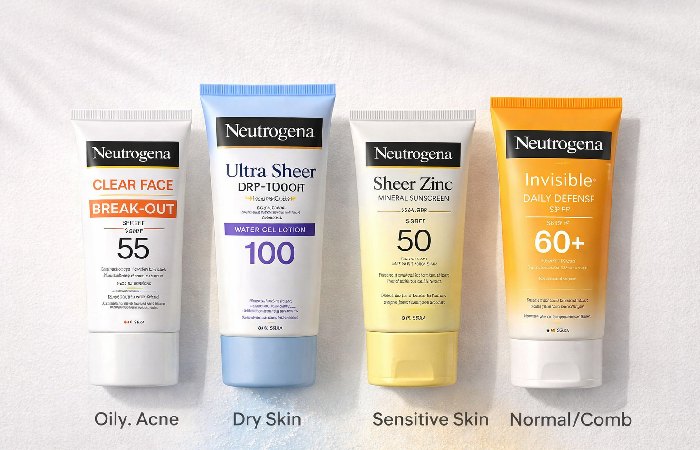
Different Neutrogena formulas suited for oily, dry, sensitive, and combination skin types.
Your skin type is one of the most important variables.
-
Oily / acne-prone skin: Look for oil-free, non-comedogenic formulas with a matte finish. Clear Face SPF 55 is designed specifically for this, and Ultra Sheer Dry-Touch SPF 100 also helps control shine.
-
Dry skin: Hydro Boost Water Gel Lotion SPF 50 is a go-to, because it combines hydration and SPF in one.
-
Sensitive / reactive skin (rosacea, eczema, allergies): Mineral options such as Sheer Zinc SPF 50 or Mineral Ultra Sheer SPF 30 are usually better tolerated. They rely on zinc oxide, are fragrance-free, and avoid the chemical filters that often sting.
-
Normal / combination skin: Most formulas can work; Invisible Daily Defense SPF 60+ is an excellent everyday option if you want a weightless, invisible finish.
For sensitive skin, dermatology organizations often recommend fragrance-free, mineral-based sunscreens and broad-spectrum SPF 30 or higher for daily protection. See the American Academy of Dermatology’s sunscreen FAQs for details:
https://www.aad.org/public/everyday-care/sun-protection/sunscreen-patients/sunscreen-faqs
### Factor 2: SPF Level
SPF (Sun Protection Factor) describes how much longer skin takes to redden with sunscreen vs without, in controlled conditions, due to UVB exposure.
-
Daily indoor / commuting use: SPF 30–50 is typically sufficient, provided you apply enough and reapply if you’re in direct sun. Many dermatologists suggest SPF 30 as a practical baseline for day-to-day life.
-
Outdoor, beach, or extended sun: Choose SPF 50 or higher. SPF 100 can offer a helpful margin of error when people apply less than the tested amount.
-
Children and very fair or easily burning skin under intense sun: Higher SPFs such as 70–100 are often recommended, alongside hats, clothing, and shade.
### Factor 3: Mineral vs Chemical Filters
This is one of the most frequently debated decisions.
| Aspect |
Mineral (Zinc Oxide / Titanium Dioxide) |
Chemical (Avobenzone, Oxybenzone, etc.) |
| How it works |
Primarily reflects and scatters UV light at the surface |
Absorbs UV and converts it to a small amount of heat in the skin |
| Best for |
Sensitive or reactive skin, some eye-area use |
Most skin types; easier full-body and cosmetic use |
| Reef considerations |
Zinc oxide/titanium dioxide generally considered reef-friendly |
Oxybenzone/octinoxate are restricted in places like Hawaii and Key West |
| FDA GRASE status |
Proposed as GRASE in FDA’s sunscreen rule updates |
Other actives are under additional evaluation |
| Typical finish |
Thicker; may leave visible cast |
Thinner textures; usually little to no cast |
| Start time |
Effective on application |
Needs around 15 minutes before sun exposure |
The
FDA’s sunscreen page provides more detail on how different actives are being evaluated. If you’re also comparing other dermatologist-developed options,
Dr. Sheth’s sunscreen is another science-backed range worth considering alongside Neutrogena.
### Factor 4: Finish & Wearability
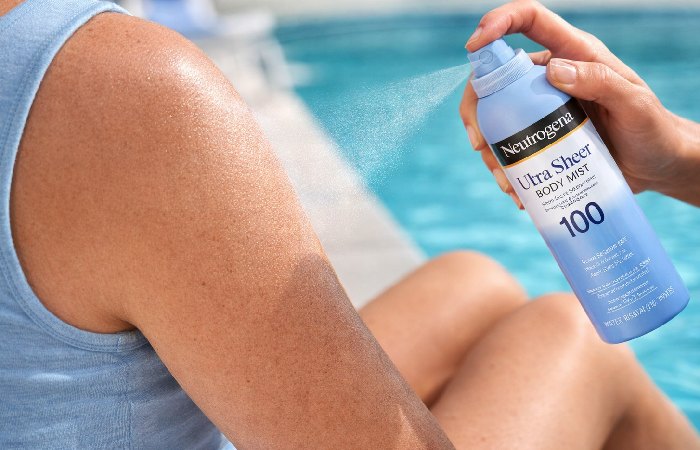
Water-resistant Neutrogena sunscreens designed for sports, swimming, and extended sun exposure.
Think about how you’ll use your sunscreen day-to-day:
-
Under makeup: Invisible Daily Defense SPF 60+ and Ultra Sheer Dry-Touch SPF 100 tend to sit smoothly under foundation without pilling.
-
Outdoor sports or swimming: Opt for water-resistant formulas rated for 80 minutes, such as Ultra Sheer SPF 100, Sheer Zinc SPF 50, or Ultra Sheer Body Mist SPF 45.
-
Minimal routines: Hydro Boost SPF 50 works well when you want a “moisturizer + SPF” step rather than multiple layers.
### Factor 5: Reef Safety & Environmental Impact
If you swim in the ocean or travel to reef-protected areas, check local regulations and ingredient lists.
-
Better choices within Neutrogena for reef-sensitive locations:
-
Sheer Zinc Dry-Touch SPF 50
-
Mineral Ultra Sheer Dry-Touch SPF 30
Regions like Hawaii and Key West have restricted sunscreens containing oxybenzone and octinoxate because of potential coral reef impacts. Choosing zinc-based formulas is one way to align with those regulations and environmental concerns.
### How to apply Neutrogena sunscreen correctly
- Use enough product: Aim for about two to three fingers’ length of sunscreen for your face and neck, or roughly half a teaspoon, and more for larger exposed areas.
- Apply as the last skincare step: Put sunscreen on after moisturizer and before makeup, giving it a minute to settle.
- Wait time for chemical filters: For chemical formulas like Ultra Sheer, Clear Face, Hydro Boost, and Invisible Daily Defense, apply at least 15 minutes before going into direct sun so the filters can form an even protective film.
- How to use sprays: For Ultra Sheer Body Mist, spray into your hands first and then rub the product onto your skin for even coverage, rather than misting from far away or in windy conditions.
- Reapply regularly: Reapply at least every two hours in direct sun, and after swimming, heavy sweating, or towel‑drying, even if the formula is water‑resistant.
## Neutrogena sunscreen – factual availability
### US availability (online and offline)
From these sources it is factually correct to say:
Neutrogena Ultra Sheer Dry‑Touch Broad Spectrum SPF 55 Sunscreen, 3 oz, is sold in the United States through large retailers such as Walmart and Target, including their online stores. A current Walmart online listing shows a single 3 oz tube of Neutrogena Ultra Sheer Dry‑Touch SPF 55 sunscreen with prices in the mid‑teens in USD depending on seller; these figures are examples only, and actual prices vary by seller, location, and promotions.
Target’s online store lists Neutrogena Ultra Sheer Dry‑Touch Sunscreen Lotion SPF 55 in a 3 fl oz tube, described as a broad‑spectrum, water‑resistant, non‑comedogenic sunscreen with a lightweight, fast‑absorbing texture.
Neutrogena provides an official US contact and support page, and a store‑locator experience for US customers, which surfaces retailers such as CVS Pharmacy, Walgreens, Target, and Walmart when a valid US location is entered. This confirms that Neutrogena products are distributed through these chains in the US market, although specific product availability and pricing differ by store.
In practical terms, US shoppers can usually find Neutrogena sunscreens both online and in physical stores at major chains, but the exact formulas stocked and the prices offered depend on the individual retailer and region.
### India online availability
From these sources it is factually correct to say:
Neutrogena sunscreens are available online in India on Flipkart, which has a dedicated Neutrogena sunscreen section. Current listings include Neutrogena Ultra Sheer Dry‑Touch SPF 50 or SPF 50+ sunblocks (for example, a 60 g Ultra Sheer Dry‑Touch SPF 50+ PA++++ Sunblock shown with an MRP of 598 INR and a discounted price of 269 INR, described as 55% off). These values are examples taken from live listings and can change over time with different offers, pack sizes, and sellers.
Neutrogena sunscreens are also available on Nykaa in India, where multiple Neutrogena sunscreen SKUs (including Ultra Sheer and Hydro Boost lines) appear on the Neutrogena sunscreen category page, with MRPs in the mid‑hundreds to low‑thousands of rupees and percentage discounts displayed on several products; prices and discount levels vary over time and by product.
BigBasket’s Neutrogena brand page confirms that Neutrogena products are sold on BigBasket in India, showing a range of skincare items priced from under 100 INR into the mid‑hundreds of rupees in the visible examples, although not every item is a sunscreen. This establishes Neutrogena as an active brand on BigBasket, but users should check individual product pages to confirm whether an item is a sunscreen or another skincare product.
For Indian shoppers, the most reliable way to check current Neutrogena sunscreen prices and availability is to search directly on Flipkart, Nykaa, or BigBasket, and review the live listings, since prices, discounts, and stock status are updated frequently.
### India offline availability – what can and cannot be asserted
From these sources it is factually correct to say:
Neutrogena is officially marketed in India by JNTL Consumer Health (India) Private Limited, as indicated in Neutrogena India’s legal notice and contact details, and in customer‑care information that lists JNTL Consumer Health (India) Private Limited’s address in Mumbai.
Publicly visible information confirms Neutrogena sunscreen availability on major Indian e‑commerce platforms (including Flipkart, Nykaa, and BigBasket), but it does not provide a comprehensive, verifiable list of all offline pharmacies, supermarkets, or beauty and personal‑care chains that stock Neutrogena sunscreens across India. Because of this, it would not be accurate to claim that Neutrogena sunscreens are available in all outlets of specific chains (for example, all Apollo Pharmacy stores, all Health & Glow locations, or all branches of particular supermarket chains) nationwide.
A more precise way to describe offline access is:
In India, Neutrogena products may be available at selected pharmacies, beauty retailers, and modern trade supermarkets, particularly in larger cities, but availability varies by location. Checking with local stores or using online platforms for home delivery or click‑and‑collect is the most reliable way to confirm whether a specific Neutrogena sunscreen is in stock near you.
## Who shouldn’t rely on sunscreen alone
In very high UV conditions or for people at higher risk of skin cancer, sunscreen should be just one part of protection, not the only line of defense. Clothing, hats, sunglasses, shade, and avoiding peak sun hours are all recommended alongside broad-spectrum SPF 30 or higher.
Talk to your doctor if you have a history of skin cancer or are on photosensitizing medications.
## Who this guide is for – and who should be cautious
This guide is most useful if you are generally healthy, want an everyday face or body sunscreen, and are choosing between the main Neutrogena ranges (Ultra Sheer, Clear Face, Hydro Boost, Sheer Zinc, Invisible Daily Defense, and Mineral Ultra Sheer). It’s designed to help you match texture, finish, and filter type to your skin and lifestyle.
You should be cautious about relying on this guide alone if you have a history of skin cancer, precancerous lesions, severe photosensitivity, or complex skin conditions such as uncontrolled eczema or lupus. In those cases, it is safer to speak with a dermatologist who can tailor sunscreen recommendations to your medical history and may suggest prescription treatments or additional protective steps.
## Conclusion: Picking Your Neutrogena SPF
Neutrogena offers enough sunscreen options that almost every skin type and routine can find a good fit. Match your choice to your skin type (oily, dry, sensitive, or combination), preferred filter type (mineral vs chemical), and how much sun exposure you actually get. For most people, the safest strategy is to pick a texture you enjoy using, apply it generously, and reapply every two hours in the sun—consistency matters more than chasing the “perfect” formula.
## FAQ: Neutrogena Sunscreen
### Q1: Which Neutrogena sunscreen is best for oily skin?
Clear Face Break-Out Free Sunscreen SPF 55 is a leading option for oily and acne-prone skin because it is oil-free, non-comedogenic, and has a matte finish. Ultra Sheer Dry-Touch SPF 100 is another strong choice if you want higher SPF with a similarly lightweight, non-greasy texture.
### Q2: Is Neutrogena sunscreen safe for sensitive skin?
Yes, with careful selection. Sheer Zinc Dry-Touch SPF 50 is generally the best fit for very sensitive, reactive, or allergy-prone skin because it uses zinc oxide only, is fragrance-free, and avoids oxybenzone. If you have rosacea, eczema, or a history of stinging with chemical sunscreens, starting with a mineral, fragrance-free product and patch-testing is a cautious approach.
### Q3: Does Neutrogena sunscreen leave a white cast?
It depends on the formula and your skin tone. Chemical sunscreens such as Ultra Sheer, Clear Face, Hydro Boost, and Invisible Daily Defense typically leave little to no visible cast on most shades. Mineral formulas like Sheer Zinc and Mineral Ultra Sheer can leave a light cast, especially on deeper skin, but applying a thin layer and blending for 60–90 seconds reduces it significantly.
### Q4: Is Neutrogena sunscreen reef-safe?
Not all Neutrogena sunscreens are reef-safe. Many of the chemical formulas contain filters such as oxybenzone and octinoxate, which are restricted in some reef-sensitive regions. If reef safety is a priority, or you’re traveling somewhere with ingredient laws, choose zinc-based options like Sheer Zinc SPF 50 or Mineral Ultra Sheer SPF 30 and check local regulations.
### Q5: Does Neutrogena sunscreen prevent tanning?
Sunscreen reduces UV reaching the skin, which in turn reduces tanning, but no product blocks 100% of UV rays. SPF 50 filters about 98% of UVB, while SPF 100 filters about 99%, assuming proper application. With correct application and frequent reapplication, Neutrogena sunscreens can significantly limit tanning and burning, but some gradual color can still develop during strong sun exposure.
### Q6: How often should I reapply Neutrogena sunscreen?
Reapply at least every 2 hours while you’re in the sun, and immediately after swimming, heavy sweating, or towel-drying, even with water-resistant formulas. Guidance from dermatology organizations emphasizes that SPF is tested at a generous application amount and doesn’t last all day without reapplication; heat, sweat, and friction all reduce the protective layer.
### Q7: What SPF should I use daily?
For everyday life, many dermatologists recommend broad-spectrum SPF 30 or higher. If you’re mainly indoors with brief outdoor time, SPF 30–50 used consistently and generously is usually enough. For long outdoor exposure, high UV index days, or very fair skin, SPF 50–100 plus hats, clothing, and shade provides a more robust safety net.
### Q8: Is Neutrogena Hydro Boost sunscreen good for dry skin?
Yes. Hydro Boost Water Gel Lotion SPF 50 is one of Neutrogena’s most suitable options for dry or dehydration-prone skin, thanks to its hyaluronic acid and gel-cream texture. It helps skin feel moisturized without heaviness and doesn’t leave a noticeable white cast, making it easy to integrate into a simple morning routine.
Choosing the best Neutrogena sunscreen comes down to matching your skin type, sensitivity, environment, and texture preferences with the right formula. Whichever option you pick, applying a generous amount and reapplying regularly will matter just as much as the specific bottle you buy.
## Methodology & Sources
-
Neutrogena official sunscreen product pages and labels used for SPF values, active ingredients, water‑resistance claims, and marketing language (Ultra Sheer, Clear Face, Hydro Boost, Sheer Zinc, Invisible Daily Defense, Mineral Ultra Sheer, Ultra Sheer Body Mist).
-
American Academy of Dermatology sunscreen FAQs and sun‑protection recommendations are used to inform advice on broad‑spectrum SPF 30+, reapplication timing, and general sun‑safety habits.
-
U.S. Food and Drug Administration communications and sunscreen rulemaking documents provide context on GRASE status for zinc oxide and titanium dioxide, and on the regulatory treatment of sunscreen actives.
About Healthbloomin
Healthbloomin publishes practical, easy-to-understand content on health, technology, business, marketing, and lifestyle. Our articles rely on reputable, publicly available information, and we use AI tools only to help with research, organisation, and clarity — so the focus stays on real-world usefulness rather than jargon or unnecessary complexity.
Disclaimer:
This guide is for general informational and educational purposes only and is not a substitute for personalized medical or dermatological advice. Sunscreen responses can vary based on your skin type, conditions, medications, and environment. Always patch-test new products and consult a qualified healthcare professional or dermatologist before starting, changing, or relying on any skincare or sun-protection routine.