Sun protection has come a long way. But here’s what most people don’t realize: standard sunscreen — even a great one — leaves a gap. It shields your skin from UV rays, but visible light and blue light can still trigger pigmentation, dark spots, and premature aging. That’s where tinted sunscreen changes the game.
Tinted sunscreen combines broad-spectrum UV protection with skin-tone pigments (primarily iron oxides) that do two jobs at once: even out your complexion and block the spectrum of light that regular SPF misses entirely.
This guide breaks down exactly what tinted sunscreen is, how the science works, and how to find the right formula for your skin type — so you stop guessing at the drugstore and start choosing with confidence.
Quick Answers Before You Read
- What is it? A sunscreen with added pigments (iron oxides) that evens skin tone while blocking UV and visible light
- Better than regular SPF? For most people, yes — especially if you have hyperpigmentation or want to skip foundation
- Who needs it most? Those with melasma, darker skin tones, or anyone bothered by white cast from mineral SPF
- Key ingredient to look for? Iron oxide — it’s what gives tinted SPF its visible-light defense
- How much to apply? A quarter-sized amount for the face — more than most people apply
What Is Tinted Sunscreen?

Close up of tinted sunscreen cream on fingertips showing natural skin tone tint
Tinted sunscreen is a multi-functional skincare product that combines broad-spectrum UV protection with cosmetic pigments — typically iron oxides — to provide light coverage while shielding skin from the sun.
It works in two ways simultaneously. The active sunscreen ingredients (zinc oxide, titanium dioxide, or chemical filters) block or absorb UVA and UVB rays. The iron oxide pigments provide the tint, even out skin tone, and — critically — absorb and scatter visible light across the 400–700nm spectrum, including high-energy visible (HEV) blue light that standard sunscreens don’t address.
Think of it as a lightweight foundation that actually protects your skin at a deeper level than coverage alone.
How Tinted Sunscreen Works
Most tinted sunscreens use a two-layer defense:
- UV filter layer — mineral (zinc oxide/titanium dioxide) or chemical (avobenzone, octinoxate) ingredients absorb or reflect UVA and UVB radiation
- Iron oxide layer — pigment particles absorb and scatter visible light and HEV blue light, preventing it from penetrating the skin and triggering melanin production
This combination makes tinted SPF especially powerful for people prone to post-inflammatory hyperpigmentation or melasma, conditions that regular SPF alone doesn’t fully protect against.
Tinted Sunscreen vs. Regular Sunscreen
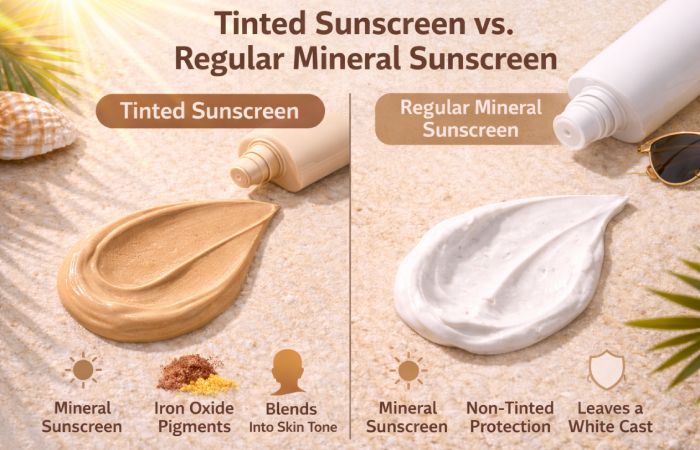
Infographic showing tinted sunscreen and regular mineral sunscreen differences.
| Feature |
Tinted Sunscreen |
Regular Sunscreen |
| UVA/UVB Protection |
✅ Yes |
✅ Yes |
| Visible Light Protection |
✅ Yes (via iron oxides) |
❌ No |
| Blue Light Defense |
✅ Yes |
❌ No |
| White Cast |
Minimal to none |
Common with mineral SPF |
| Light Coverage |
✅ Yes |
❌ No |
| Makeup Base Use |
✅ Yes |
❌ No |
| Best for Hyperpigmentation |
✅ Yes |
Partial |
| Shade Range Required |
Yes |
No |
The core advantage of tinted sunscreen isn’t cosmetic — it’s the iron oxide visible-light protection that adds a meaningful layer of defense your regular SPF isn’t providing.
The Science Behind the Tint — Iron Oxide Explained

Iron oxide pigments help tinted sunscreen absorb and scatter visible light.
Iron oxide is the ingredient that makes tinted sunscreen worth the upgrade. And it’s not just about coverage.
What Iron Oxide Does for Your Skin
Iron oxides are mineral pigments (red, yellow, and black) blended in ratios to match various skin tones. Beyond their cosmetic role, they are highly effective at absorbing and scattering light across the visible spectrum (400–700 nm).
This matters because visible light — including the blue light emitted by screens and sunlight — can penetrate deeply into skin, stimulating melanocytes and triggering hyperpigmentation. Research published in studies cited by the National Institutes of Health on iron oxide and visible light protection confirms that iron oxide significantly reduces visible light transmission to skin.
Studies have shown that some iron‑oxide tinted sunscreens can reduce visible light transmission by around 80–90%, though the exact level depends on the specific formula and shade depth.
Blue Light and Visible Light Protection
Visible light sits between UV radiation and infrared on the light spectrum. It’s what gives sunlight its color and what your phone or laptop screen emits.
For most people, visible light exposure is moderate and manageable. But for those with:
- Melasma — visible light is a direct trigger for flares
- Post-inflammatory hyperpigmentation (PIH) — especially common in medium-to-deep skin tones
- Photoaging concerns — HEV light contributes to oxidative skin damage
…tinted sunscreen with iron oxides isn’t just a cosmetic upgrade. It’s a clinical one.
Key Ingredients to Look for in a Tinted Sunscreen
Not all tinted sunscreens are formulated equally. Here’s what the label should tell you — and what each ingredient actually does.
Mineral Filters: Zinc Oxide and Titanium Dioxide
Mineral filters are the gold standard for sensitive, acne-prone, and reactive skin. They work by sitting on the skin’s surface and physically deflecting UV rays, rather than absorbing them into skin cells.
- Zinc oxide — broad-spectrum (UVA + UVB), anti-inflammatory, reef-safe, immediate protection on application
- Titanium dioxide — stronger UVB coverage, often combined with zinc oxide for full-spectrum defense
The downside? Both can leave a white cast on deeper skin tones — something mineral formulas like Dr. Sheth’s sunscreen address through thoughtful tinted blending.
Chemical Filters: How They Differ
Chemical sunscreens (avobenzone, octinoxate, homosalate) work by absorbing UV radiation and converting it to heat. They’re typically lighter in texture and easier to blend, with no white cast.
The trade-off:
- Need 20 minutes post-application to activate
- Can irritate sensitive skin in some formulations
- Some filters (oxybenzone) have raised systemic absorption questions, though FDA is still evaluating evidence
Many tinted sunscreens are hybrid formulas combining mineral and chemical filters for coverage, cosmetics, and protection balance.
Bonus Skincare Ingredients
The best tinted SPFs do double duty as leave-on treatments:
- Hyaluronic acid — humectant that draws moisture to skin; ideal for dry skin types
- Niacinamide — minimizes pores, reduces redness, improves skin tone over time
- Vitamin C / antioxidants — neutralize free radicals triggered by UV and pollution
- Squalane — lightweight emollient for plump, non-greasy hydration
These ingredients don’t affect SPF efficacy — they enhance the overall skincare benefit of wearing SPF daily. Pair your tinted SPF routine with foods that support skin health for deeper, inside-out protection.
How to Choose Tinted Sunscreen for Your Skin Type
The right tinted sunscreen depends on your skin type, concerns, and how you want it to look on your face. Use this framework to narrow your options.
The 4-Factor Tinted SPF Selector
Before buying, ask yourself:
- SPF level — SPF 30 minimum; SPF 50 for high UV exposure or hyperpigmentation
- Filter type — Mineral for sensitive/acne skin; chemical or hybrid for lightweight texture
- Finish — Matte (oily skin), dewy (dry skin), natural/satin (combo/normal)
- Shade match — Look for brands with 3+ shades; check undertone (warm/cool/neutral)
| Skin Type |
Best Filter |
Finish |
Key Ingredient |
Avoid |
| Oily / Acne-Prone |
Mineral (zinc oxide) |
Matte |
Niacinamide |
Coconut oil, heavy emollients |
| Dry / Mature |
Mineral or hybrid |
Dewy / Satin |
Hyaluronic acid, squalane |
Alcohol-heavy formulas |
| Sensitive / Rosacea |
Mineral only |
Satin / Natural |
Zinc oxide, no fragrance |
Chemical filters, fragrance |
| Darker Skin Tones |
Tinted mineral |
Natural |
Iron oxide, vitamin C |
Single-shade “universal” tints |
| Hyperpigmentation |
Tinted mineral (SPF 50) |
Any |
Iron oxide + niacinamide |
Untinted mineral SPF |
Best Tinted Sunscreen for Oily and Acne-Prone Skin
Look for non-comedogenic, oil-free mineral formulas with a matte or semi-matte finish. Zinc oxide is your best friend here — it’s anti-inflammatory and won’t clog pores. Niacinamide as an added ingredient helps manage oil production and reduce the appearance of pores over time.
Avoid formulas with heavy oils (coconut, castor) or occlusive ingredients high on the ingredient list.
Best Tinted Sunscreen for Dry and Mature Skin
Choose formulas enriched with hyaluronic acid, squalane, or glycerin for all-day hydration. A dewy or satin finish will look more natural and avoid the powdery effect that matte finulas can create on dry patches.
Hybrid formulas (mineral + chemical) often have smoother textures that feel comfortable on dry skin without settling into fine lines.
Best Tinted Sunscreen for Sensitive Skin
Stick to 100% mineral formulas — zinc oxide and titanium dioxide — free of fragrance, essential oils, and common chemical filter irritants like oxybenzone and octinoxate. Look for “hypoallergenic” and “dermatologist-tested” on the label.
Per AAD’s sunscreen guidelines, mineral-based sunscreens are consistently recommended for those with sensitive or reactive skin conditions including eczema and rosacea.
Best Tinted Sunscreen for Darker Skin Tones
This is where brand selection matters most. A single “universal” tint rarely works for deep or rich skin tones — it can appear ashy or grey. Look for brands offering at least 3–5 shades with warm and deep options.
The iron oxide protection benefit is also most significant for darker skin tones, given higher melasma and PIH risk from visible light exposure. Prioritize SPF 50 tinted mineral formulas with confirmed iron oxide in the ingredient list.
How to Apply Tinted Sunscreen Correctly
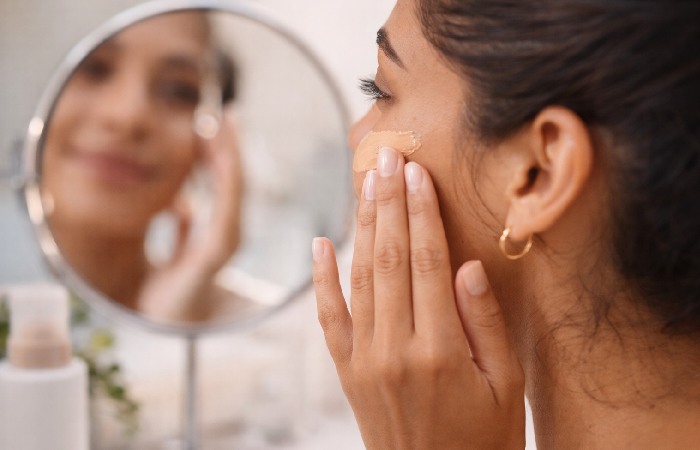
Applying enough sunscreen is essential to achieve the labeled SPF protection.
Getting the right formula is step one. Applying it correctly is where most people shortchange themselves.
How Much Is Enough? (The SPF Dosing Problem)
Here’s a fact that changes how you shop: most people apply only 20–50% of the recommended amount of sunscreen, which dramatically reduces effective SPF protection.
The SPF on the label is tested at 2mg/cm² of skin — for the average adult face, that translates to roughly:
- A quarter-sized dollop for face alone
- Two full finger-lengths of product to cover face and neck
If you apply a thin layer to “look natural,” you may be getting a fraction of the SPF 50 you paid for. The tinted finish actually helps here — you can see coverage, making it slightly easier to gauge application amount.
Per FDA guidelines on sunscreen labeling and broad-spectrum protection, reapplication every 2 hours (or after swimming/sweating) is essential regardless of SPF level.
Application Order in Your Skincare Routine
- Cleanse and tone
- Serums (vitamin C, hyaluronic acid)
- Moisturizer (if needed — many tinted SPFs have enough moisture)
- Tinted sunscreen — always last in the AM skincare routine, before makeup
- Optional: set with a light pressed powder (does not meaningfully reduce SPF)
- Reapply every 2 hours using a mineral powder SPF or a second layer if heavy sun exposure
Do not mix tinted sunscreen into foundation or moisturizer — diluting the formula reduces SPF efficacy.
Common Mistakes to Avoid with Tinted Sunscreen
- Applying too little — By far the most common mistake. Use a quarter-size amount, minimum
- Skipping reapplication — SPF wears off; reapply every 2 hours outdoors
- Choosing the wrong shade — Test on your jawline in natural light, not indoor fluorescent light
- Assuming one product covers all needs — A tinted SPF 30 on a high-UV beach day may not be sufficient alone
- Mixing it with foundation or moisturizer — Dilutes the formula and reduces protection
- Using it indoors only — UVA rays penetrate glass; daily use protects against year-round aging
- Ignoring the neck — Most people apply to face only; apply down to the décolletage
Who Should Use Tinted Sunscreen — and Who Might Want to Skip It
Best For:
- People bothered by white cast from mineral sunscreens
- Anyone with melasma, hyperpigmentation, or PIH who needs visible-light protection
- Those who want to simplify their AM routine (SPF + light coverage in one step)
- Acne-prone skin that benefits from non-comedogenic, zinc-based SPF
- Anyone who wears light foundation or BB cream daily
Who Might Want to Skip It (or Supplement):
- Very deep skin tones where shade matching is limited — consider layering an untinted SPF 50 under a full-coverage foundation instead
- Those needing full coverage for significant skin concerns — tinted SPF provides sheer-to-light coverage, not concealer-level results
- Outdoor athletes or swimmers — water-resistant chemical formulas (not tinted) often perform better under heavy sweat
- Anyone needing SPF 70+ — most tinted formulas cap at SPF 50
Frequently Asked Questions
Q1: What is tinted sunscreen and how does it work?
Tinted sunscreen is a broad-spectrum UV protectant that also contains iron oxide pigments to even out skin tone. It works by combining UV-blocking ingredients (zinc oxide, titanium dioxide, or chemical filters) with iron oxides that absorb and scatter visible and blue light — offering protection beyond what standard SPF provides.
Q2: Is tinted sunscreen better than regular sunscreen?
For most people, yes — particularly for those concerned with hyperpigmentation, melasma, or white cast from mineral formulas. Tinted sunscreens with iron oxides provide an additional layer of visible-light protection that regular sunscreen lacks. For general UV protection without cosmetic concerns, a regular SPF works equally well.
Q3: Does tinted sunscreen replace foundation?
It can — but with realistic expectations. Tinted sunscreen provides sheer-to-light coverage, similar to a tinted moisturizer or BB cream. It blurs minor redness, uneven tone, and small imperfections beautifully. For significant coverage needs (blemishes, dark circles, textural concerns), you’ll still want a concealer or foundation on top.
Q4: Can tinted sunscreen cause acne or clog pores?
Not if you choose the right formula. Look for products labeled non-comedogenic — specifically mineral formulas with zinc oxide, which is anti-inflammatory and safe for acne-prone skin. Avoid heavy-oil formulations or those with pore-clogging ingredients like coconut oil or isopropyl myristate high on the ingredient list.
Q5: How much tinted sunscreen should I apply to get full SPF protection?
Apply a quarter-sized amount for the face alone — more than most people use. SPF is lab-tested at 2mg/cm², so under-application (the most common mistake) significantly reduces effective protection. If a self-conscious amount looks heavy, wait 60 seconds for absorption before blending gently with fingertips.
Q6: What’s the best tinted sunscreen for dark skin tones?
Look for brands offering multiple shades with warm/deep undertones and confirmed iron oxide in the ingredient list — iron oxide provides crucial visible-light protection, especially relevant for darker skin tones prone to PIH and melasma. Prioritize SPF 50 tinted mineral formulas and test shades on the jawline in outdoor light before committing.
Final Verdict
Tinted sunscreen is one of the most practical upgrades you can make to your AM routine — but only if you choose and use it correctly.
The science is clear: iron oxide adds meaningful visible-light protection that regular SPF skips entirely. For anyone managing hyperpigmentation, melasma, or wanting to simplify their routine without sacrificing sun defense, tinted SPF is the smarter choice.
Use the 4-Factor Selector (SPF → Filter → Finish → Shade) to find your formula. Apply generously. Reapply at midday. And drop the idea that a thin layer is “good enough” — your future skin will thank you.
About Healthbloomin
Healthbloomin publishes practical, easy-to-understand content on health, technology, business, marketing, and lifestyle. Articles are based mainly on reputable, publicly available information, with AI tools used only to help research, organise, and explain topics more clearly so the focus stays on real‑world usefulness rather than jargon or unnecessary complexity.
Disclaimer
This article is for general skincare information only and is not medical advice. Always consult a dermatologist or healthcare professional about your specific skin concerns, conditions, or treatments.